
 Türkçe
 English
What I Learned Buying My First Sailboat: Boat Selection Criteria
Dear reader,
Buying a second-hand sailboat is not just acquiring a means of transportation, it’s a lifestyle choice. In this post, I’ve tried to give a comprehensive overview of the criteria and key questions worth considering. Details like the boat’s technical condition, history, maintenance record, and navigation features will guide you toward the choice that best suits you.
I put this post together from what I learned during the adventure of buying my first sailboat. I hope it’s useful for you too.
Table of Contents
Defining Your Boat Criteria
Once you start searching for the sailboat of your dreams, or the one you can realistically make happen, the first step is making that choice. From there, the headings below can help you settle on the model that fits your lifestyle and standards.
1. Deciding by brand
In the sailboat world, the ranking known as the "famous five" (the five most popular brands) stands out here; these are Jeanneau, Beneteau, Bavaria, Hanse, and Dufour. These brands are French, German, and Slovenian manufacturers that have been building sailing and motor boats for a long time. They’re also especially common among charter fleets.
Beyond those, let’s also look at brands where craftsmanship and detail are held to a higher standard: Moody, Hallberg Rassy, Solaris, Nautor Swan, Amel, Oyster, Hinckley, Wally.
Beyond these brands, there’s a very wide range of other options out there. For more brands and options, you can check the Wikipedia page.
Focusing on brand alone isn’t enough to choose a boat, but studying these brands' models will give you a feel for things and help you make more informed decisions when weighing the other criteria. I’d especially recommend following the second-hand listings for these brands.
2. Deciding by rig plan
A sailboat’s rig plan describes the number of masts and the sail layout. This choice directly affects the boat’s performance, ease of handling, and sailing character. Here are the most common rig plans:
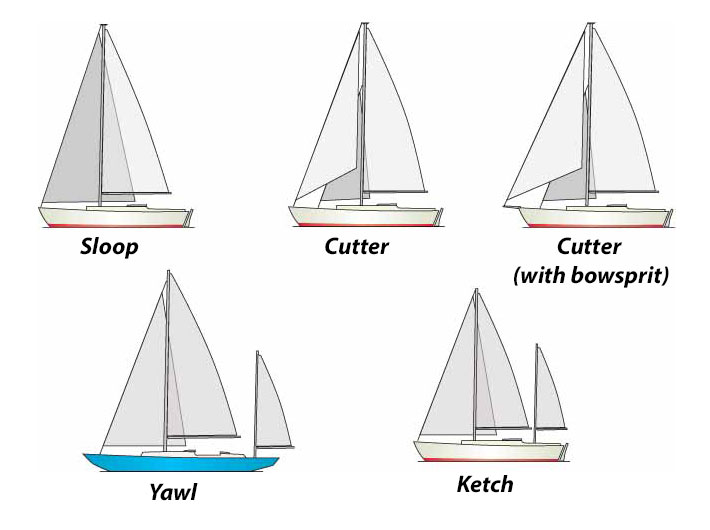
2.1.1 Ketch rigged sailboats generally have a two-masted structure. The mainmast is larger and set further forward, while the mizzen (second mast) is smaller. Ketches offer more sail area, which usually means more flexibility and performance. They’re ideal for long-distance passages and can offer more living space aboard.
2.1.2 Yawl rigged sailboats are also two-masted, but the mizzen mast sits further aft than on a ketch, behind the rudder post. This placement generally makes the mizzen sail smaller, and it’s mostly used for balance. Yawls are known for their classic looks and ease of handling, though they offer less sail area than a ketch. They can be used for long passages, but have a narrower range of use compared to ketches.
2.1.3 Cutter rigged sailboats generally have a single mast but carry more than one headsail (for example, a genoa and a staysail). This design offers more flexibility with sail combinations, especially in windy conditions. Cutters are particularly well suited to long-distance passages and are easy to handle. Modern cutters offer a combination of performance and comfort.
2.1.4 Sloop rigged boats generally have a single mast and a simple layout. These boats typically carry one mainsail and one headsail (a jib or genoa). Sloops are known for being easy to handle and for their balanced sailing characteristics. They’re ideal for day trips, leisure, and light sailing. The modern sloop is a popular choice for both beginners and experienced sailors alike.
If you’re new to sailing, these model options might not mean much to you yet. Today, the sloop design is by far the most popular choice.
3. Deciding by hull type
Hull type determines the boat’s basic structure and how it behaves on the water:
Hull Types
Monohull: The most common hull type.
Offers balanced performance and the classic sailing experience.
Catamaran: Made up of two parallel hulls.
Offers more living space and stability.
Trimaran: Made up of one main hull and two outer hulls.
Offers high performance and stability.
A Note on Marina Costs:
Marina fees are generally calculated based on the space a boat takes up.
Since catamarans and trimarans take up more space, their marina and winter storage costs are significantly higher than monohulls.
This difference can meaningfully affect your annual running costs.
4. Deciding by stern design
The stern is the name given to the back part of the boat. A boat’s stern design meaningfully affects both performance and how it can be used. Different stern designs offer different advantages; some provide more storage space, while others offer better performance or more room for socializing.
Canoe Stern (Classic Design):
A rounded stern shape, often seen on classic-looking boats.
Offers more storage space but can be somewhat slower than modern boats.
Who is it for?
Sailors who love a traditional and aesthetic boat.
Transom Stern:
A more modern design that generally offers a wider cockpit area.
Preferred on fast, performance-oriented boats.
Who is it for?
Those looking for a race-oriented or modern-looking boat.
Reverse Transom / Raised Deck Stern:
A design that provides a wide living space and stability.
Who is it for?
Those looking for a spacious and stable seagoing experience.
Hulls With a Swim Platform:
Common on modern boats — an openable swim platform at the stern.
This platform makes it easy to get into the water and adds a lot of comfort, especially at anchor.
Swim platforms are a big advantage for families with children or anyone who swims often.
Who is it for?
Those who love water activities and are looking for a boat suited to socializing.
5. Deciding by keel type
The keel is one of the most important structural elements for keeping a boat balanced and moving stably through the water. Keel type varies significantly depending on the boat’s intended use, performance, and typical sailing conditions.
Keel Types
Fin Keel:
A more modern design that generally offers better turning ability and speed.
However, it requires more care in shallow water and channels.
Swing Keel:
The keel is hinged to the boat and can be raised.
An advantage in shallow water, rivers and canals, or when hauling out.
Lifting Keel:
The keel can be raised via a hydraulic or mechanical system.
Offers similar advantages to a swing keel, but is usually a more complex mechanism.
An advantage in shallow water and river/canal passages.
Full-Length Keel:
Integrated into the boat’s structure and generally fixed.
Provides a sturdier build but is more limited in flexibility.
However, turning ability is more limited compared to modern fin keels.
Twin Keel:
Has two parallel keels.
An advantage in shallow water and can keep the boat stable if it takes the ground, or offer secure anchoring in tidal waters.
6. Deciding by year built
Year built is an important factor to consider when buying a boat. Are you looking for a new boat, or dreaming of a vintage model? Your answer to that question will narrow your options considerably.
Vintage Boats:
Vintage boats generally stand out for having more character and a classic design.
Brands like Albin, Ericson, Hans Christian, and FinSailer, for example, have left their mark on sailing history and still produce vintage models that are sought after today.
That said, keep in mind that maintaining and restoring these boats can be more costly than with modern boats.
Modern Boats:
New-build boats are generally fitted with more advanced materials and technology.
They require less maintenance and offer advantages in energy efficiency and comfort.
Electrical systems, navigation equipment, and safety features tend to be more modern.
Tips for Choosing a Year:
If you’re looking at a model built between 1970-1990, pay close attention to build quality and the materials used.
Boats built in certain periods may have had manufacturing defects or lower-quality materials.
It’s also worth researching the technology used in different eras to judge whether it fits your needs.
7. Deciding by size & beam
A boat’s dimensions are a decisive factor in how and where you’ll use it. Both length (LOA) and beam play an important role in comfort, performance, and intended use.
What is a "Foot"?
Feet is a unit commonly used in sailing to measure boat dimensions.
1 foot is roughly equal to 30.48 cm.
For example, a 30-foot boat is roughly 9.14 meters long.
7.1 Length (LOA - Length Overall):
Small Boats (20-30 feet):
Ideal for day trips or short passages.
Require less equipment and maintenance, and are more economical in terms of marina fees and transportability.
Recommended for beginner sailors.
Mid-Size Boats (30-45 feet):
A great balance for both short and long-distance passages.
Offers generous living space, equipment capacity, and stability.
Well suited to couples or small families.
Large Boats (45+ feet):
Ideal for long passages or offshore voyages.
Offer more space and comfort, but come with higher usage, maintenance, and marina costs.
Recommended for experienced sailors.
7.2 Beam:
Narrow Boats:
Offer a faster, more balanced sail.
Common on traditional sailboat designs.
However, they’re more limited in terms of interior living space.
Wide Boats:
Commonly preferred on modern boats.
Offer more living space and a more stable sailing experience.
However, be mindful of wind resistance and maneuverability in narrow channels.
Marina Fees and the LOA & Beam Relationship
Marinas generally price based on a boat’s LOA (length) and beam (width) measurements.
Larger boats take up more space due to their length and width, which leads to higher marina fees.
When choosing a boat, it’s worth getting in touch with marinas in your area for pricing.
Different Pricing Methods in Europe and Turkey
In European countries, marina fees are generally calculated based on the boat’s length (LOA).
For example, since my boat is 9.50 meters long, I get a price advantage by falling into the under-10-meter category.
In Turkey, though, it’s different — marina fees are generally calculated based on square meters (m²), meaning both length and beam are taken into account.
So for accurate budget planning, it’s best to contact marinas in your area directly for exact figures.
8. Deciding by build material
A boat’s build material affects everything from maintenance needs to performance, lifespan, and cost. Here are the most common build materials:
Fiberglass (GRP - Glass Reinforced Plastic):
The main material used in most modern boats.
Easy to maintain and durable.
Relatively simple to repair.
Can be affected by UV exposure.
Who is it for?
Those looking for low maintenance costs and first-time boat owners.
Wood:
Traditional and aesthetic look.
Requires ongoing maintenance.
Can last a very long time if well cared for.
Requires skilled craftsmanship.
Who is it for?
Classic boat enthusiasts and experienced sailors who know woodworking.
Steel:
Very durable and safe.
Being heavy affects performance.
Requires regular maintenance against corrosion.
Resistant to impact.
Who is it for?
Long-distance voyagers and those planning to sail in demanding conditions.
Aluminum:
Light and durable.
Low maintenance needs.
High upfront cost.
Watch out for electrolysis issues.
Who is it for?
Those looking for performance and higher-budget buyers.
Ferrocement:
Low cost.
Heavy build.
Difficult to repair.
Low resale value.
Who is it for?
Low-budget and DIY project seekers.
Composite:
Modern and high-performing.
Very light and durable.
High cost.
Repairs require specialist skill.
Who is it for?
Racers and those seeking a top-tier boat.
It’s also worth weighing these points when making your choice:
-
Your intended use
-
The time and budget you can set aside for maintenance
-
Marina, haul-out, and anchoring options in your area
-
Repair options in your area
-
Resale value
-
Insurance costs
-
Local climate conditions
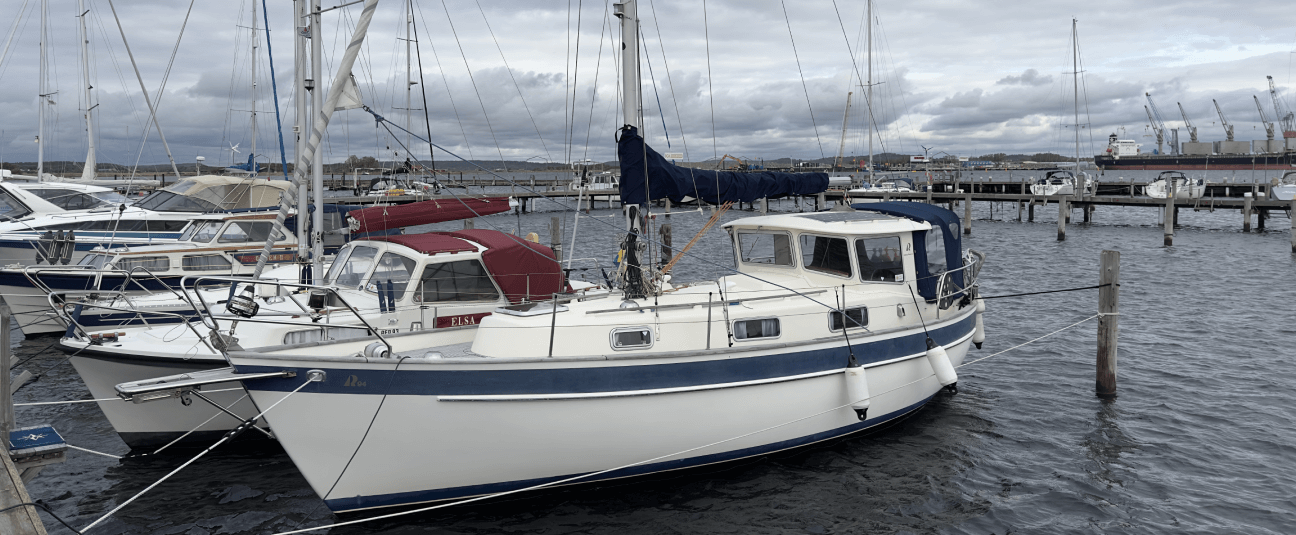
When buying my first boat, a Hallberg Rassy 94 Cutter, I weighed all of these criteria, and my priority was being able to head out to sea safely and comfortably. In the end I settled on this Swedish-built vintage boat from 1981 — its classic canoe stern design, sturdy build, and top-tier craftsmanship were exactly what I was looking for. Your priorities and dreams may be different from mine; what matters is keeping your own needs and expectations front and center while weighing these fundamental criteria.
In my next post, I’ll share the technical details worth paying attention to when buying a used boat, based on my own experience and what I learned during the buying process.